- Website budgeting
How Much Does a WordPress Website Cost for a Small Business?
What actually drives the price of a small business WordPress website, what published estimates say in 2026, and what to budget for after launch, so you can compare quotes on scope instead of on the headline number.
- By Arslan Kalwar
- October 9, 2026
- 13 min read
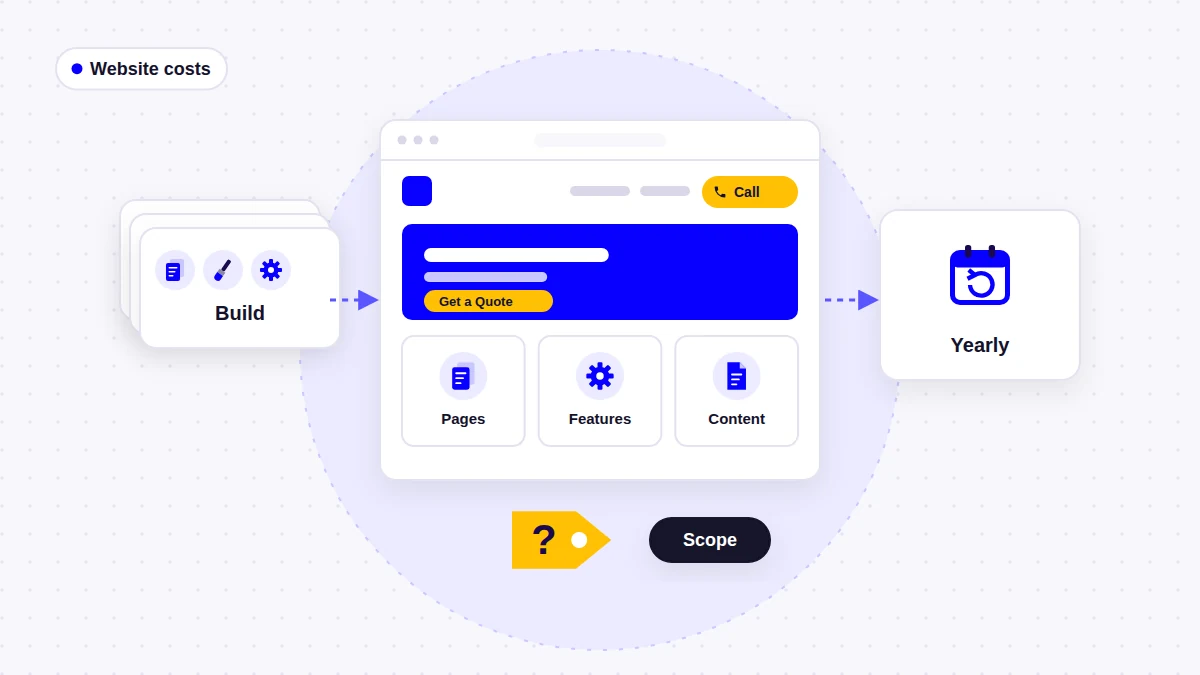
“How much does a website cost?” is usually the first question a business owner asks me, and the honest answer is that it depends on what the website has to do. A five-page site for a local plumber and a 40-page site with online booking and a CRM connection are both “a WordPress website”, but they are very different projects.
So instead of inventing one number, this guide explains what drives WordPress website cost for a small business, shows what several named sources currently publish as estimates, and covers the yearly costs that many quotes leave out.
- Quick answer
There is no single price for a small business WordPress website. The cost depends mainly on:
- How many pages and page templates the site needs
- Template-based design or custom design
- Who writes the content and supplies the photos
- Features such as booking, ecommerce or CRM integrations
- Who builds it: DIY, a freelancer or an agency
- Ongoing costs: hosting, domain, licenses and maintenance
- Published 2026 estimates for a professionally built small business site mostly start in the low thousands of dollars, with yearly running costs on top
Why WordPress Website Cost Varies So Much
WordPress itself is free software. What you pay for is everything around it: the planning, design, building, content, setup and the services that keep the site online. Each of those can be small or large depending on the business.
Two quotes for “a small business website” can differ by thousands of dollars because they describe different amounts of work. One might mean a template with your logo and five short pages. Another might include a site structure plan, individual service pages, written content, SEO setup, form routing and training. Comparing them on price alone is comparing different products.
What Affects the Cost of a WordPress Website
These are the factors that move the price most on the small business sites I build. The table summarizes them, and the sections below explain each one.
| Cost driver | Keeps cost lower | Pushes cost higher |
|---|---|---|
| Number of pages | A few core pages | Many service, location or project pages |
| Design | Adapted template or design kit | Fully custom design for every template |
| Content | You supply final text and photos | Copywriting, photography, rewrites |
| SEO setup | Basic titles, headings, sitemap | Keyword research, page planning, schema |
| Forms | One simple contact form | Multi-step quotes, uploads, routing |
| Integrations | None, or a booking link | CRM, booking, payments, custom APIs |
| Ecommerce | No online sales | WooCommerce store with products and shipping |
| Who builds it | DIY or freelancer | Agency team with project management |
Number of pages
Page count is the most visible cost driver, but what matters more is how many different kinds of pages there are. Ten service pages that share one layout take less design time than ten pages that each need their own structure. Still, every page needs content, images, a title, a description and testing on mobile.
For most local service businesses, the useful pages are a homepage, one page per main service, an about page, a contact page and sometimes service area pages.
Design complexity: template vs custom
A template or theme gives you a ready-made layout that is adjusted with your logo, colors and content. It is quicker and cheaper, and for many small businesses it is enough. The risk is that the template decides the structure instead of your business deciding it.
Custom design means the layouts are planned around your services and customers. It costs more because someone has to design and build each page template, then test it on different screens. Most small business projects sit in between: a solid framework, with custom layouts for the pages that matter most, such as the homepage and service pages.
Elementor and other page builders
I build on Elementor, which lets a designer create custom layouts faster than hand-coding a theme and lets you edit text and images later without a developer. That usually lowers the build cost compared with fully custom code. Two things to ask about:
- Licenses: Elementor Pro and many premium plugins are annual licenses. Ask whose name they are under and who renews them.
- Build quality: a page builder can produce a fast, tidy site or a slow, cluttered one. How it is used matters more than which builder it is.
Content: text and photos
Content is the cost most often left out of a quote. If you supply finished text and real photos, the build is faster. If the designer has to write service descriptions, interview you about your process or source images, that is real work and should be priced as such. Elementor’s own small business cost guide lists copywriting and photography as separate line items for this reason (Elementor, updated June 2026).
SEO setup
Basic on-page SEO, such as unique page titles, meta descriptions, a clear heading structure, an XML sitemap and indexable pages, should be part of any professional build. Keyword research, page planning around search terms and structured data take more time. Ongoing SEO work after launch is a separate service. Be careful with anyone who prices SEO around guaranteed rankings: Google says no one can guarantee a #1 ranking (Google, Do you need an SEO?). My WordPress SEO services page explains what the technical foundation includes.
Forms
A simple contact form is quick. A quote request form that asks for the service, address, photos of the problem and preferred contact time, then sends the request to the right person and a confirmation to the customer, takes longer to build and test. For contractors, this form is often the most important part of the site, so it is worth getting right.
Integrations
Connecting the website to other systems adds cost: online booking, a CRM, email marketing, review widgets, financing applications or job management software. Some tools offer a simple embed that takes minutes. Others need configuration, testing and occasional fixes when the third-party tool changes.
Ecommerce
Selling online with WooCommerce is a different category of project. Products, variations, shipping, taxes, payments, order emails and stock all need setting up, and hosting usually needs to be stronger. OuterBox lists WooCommerce builds as a separate tier well above a basic small business site (OuterBox, updated September 2026). Most service businesses do not need a store, and a quote request form does the job.
Hosting and domain
These are small compared with the build, but they recur every year. Watch for introductory hosting prices: FS Code notes that renewal rates are usually two to four times higher than the first-term price (FS Code, updated July 2026). Make sure both the domain and the hosting account are in your name.
Maintenance
WordPress, themes and plugins release updates regularly, and WordPress’s own security guidance starts with keeping them updated (Hardening WordPress). Someone has to do that, keep backups and check that forms still work. You can do it yourself or pay for a plan, but it is never zero. I cover what is involved on the WordPress maintenance page.
Template, Semi-Custom or Custom: Typical Project Tiers
Rather than price tiers, it helps to think in terms of scope. These are the three kinds of small business WordPress projects I see most often.
| Project type | Typical scope | Who it suits |
|---|---|---|
| Starter / template-based | Template adapted with your branding, about 3 to 6 pages, simple contact form, your content | New businesses testing the market, tight budgets |
| Small business service site | Planned structure, one page per main service, quote form, basic SEO setup, mobile-first layouts | Most contractors, trades and local service businesses |
| Larger or custom build | Custom design, many service or area pages, integrations, copywriting, migration from an old site | Established businesses with several services or locations |
A store, a membership area or custom functionality sits above all three and should be quoted separately.
What Published Estimates Say in 2026
Several WordPress companies and agencies publish cost ranges. They are useful as a reality check, not as a price list. I checked these in October 2026; each source defines “small business site” a little differently, and they are mostly US-focused.
| Source (last updated) | What they estimate | Published range (USD) |
|---|---|---|
| WPZOOM (Sept 2026) | Small business site, 5 to 10 pages | Freelancer $1,500 to $5,000; agency $5,000 to $15,000 |
| FS Code (July 2026) | 5-page business site, professionally built | Freelancer $2,000 to $5,000; agency $8,000 to $20,000 |
| OuterBox (Sept 2026) | Basic professional small business site | $2,500 to $10,000+ |
| Elementor blog (June 2026) | Brochure site, 5 to 10 pages | Freelancer $2,000 to $8,000; agency $10,000 to $35,000 |
| cmsMinds (Mar 2026) | Small business site on a ready-made theme | $500 to $2,000 (custom theme $3,000 to $10,000) |
A few patterns stand out. Freelancer estimates cluster in the low thousands of dollars and agency estimates run several times higher. Template-based builds are cheaper than custom ones in every source. And the ranges overlap heavily, because scope, location and experience vary so much.
Location matters too. Upwork reports a median hourly rate of $20 for WordPress developers, based on historical contracts worldwide (Upwork, checked October 2026), while FS Code puts US, UK and Australian freelancers at $75 to $200 an hour. The same project can be priced very differently depending on where the person building it lives and how much of the work they include.
For transparency: as of October 2026, my two WordPress website design Gigs on Fiverr have a starting price of $225. That is the entry package, not a typical project total. The final price depends on the number of pages, content, features and support, and I send a scoped quote once I know what the site needs.
Freelancer vs Agency: How It Changes the Cost
Who builds the site is one of the biggest cost variables in every source above. Neither option is automatically better.
| Freelancer | Agency | |
|---|---|---|
| Price | Usually lower | Usually higher |
| Who does the work | One person, sometimes with help | Designers, developers, writers, a project manager |
| Communication | Direct with the person building | Through an account or project manager |
| Best for | Small and mid-size sites with clear scope | Large sites, many stakeholders, ongoing campaigns |
| Risk to check | Availability and backup if they are away | Paying for layers you do not need |
For a typical local service business, an experienced freelancer who specializes in your kind of site is often the most cost-effective choice. If you are hiring through a marketplace, my guide on how to choose a WordPress developer on Fiverr covers what to check.
What a Small Business Should Actually Budget For
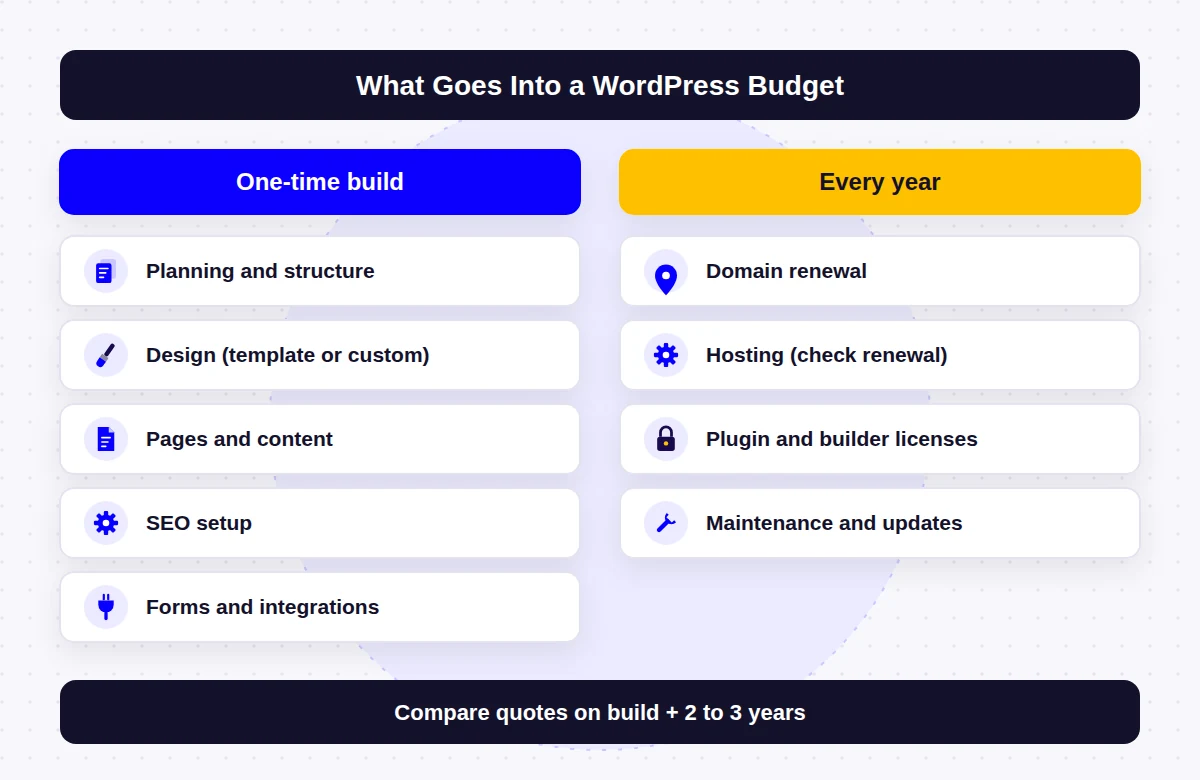
A realistic budget has two parts: the one-time build and the yearly cost of keeping the site running. Many owners plan only for the first.
One-time costs
- Planning and site structure
- Design and build of the page templates
- Content: writing, editing and photos (yours or paid)
- Basic SEO setup and analytics
- Forms, integrations and any special features
- Premium theme or plugin licenses for the first year, if not already included
Yearly running costs
| Item | Published estimate | Notes |
|---|---|---|
| Domain | $10 to $20 a year (WPZOOM, FS Code) | Specialty extensions cost more |
| Hosting | Shared $3 to $15 a month; managed WordPress $20 to $100+ (FS Code) | Check the renewal price, not the first-term offer |
| Premium licenses | Plugins $0 to $200+ a year (WPZOOM) | Page builder, forms, backups, SEO tools |
| Maintenance | Care plans $50 to $200 a month (FS Code, WPBeginner) | Or your own time for updates and backups |
| Content updates | Varies | New services, photos, reviews, seasonal changes |
FS Code estimates year-two costs of roughly $300 to $600 for a freelancer-built site and $500 to $2,500 for an agency-built one, before paid maintenance. WPBeginner puts a small business WordPress site at about $300 to $1,000 a year in running costs (WPBeginner, updated September 2025). Elementor’s guide suggests adding 10 to 20% to the build budget for costs that come up during the project.
When you compare quotes, add the build price to two or three years of running costs. A cheaper build that needs paid fixes, expensive renewals or a rebuild in two years is not the cheaper option.
What Cheap Website Offers May Leave Out
Low prices are not always a problem. Sometimes a simple site is all a business needs. But very low offers usually save money by leaving something out, and it helps to know what:
- Planning: no discussion of your services, customers or areas, so the site follows the template instead of your business
- Content: placeholder or generic text that you have to replace yourself
- Real page count: “5 pages” that turns out to be sections on one page
- Mobile testing: layouts that technically shrink but are awkward to use on a phone
- SEO basics: missing titles, duplicate descriptions, no sitemap, pages set to noindex
- Licenses: premium plugins on the builder’s license, which stop updating when they cancel it
- Ownership: hosting or domain in the builder’s name
- Speed: uncompressed images and too many plugins
- Support: nothing after delivery, not even fixing a broken form
None of these are visible on launch day, which is why they are easy to miss in a quote.
What About Redesigning an Existing Website?
If you already have a WordPress site, a redesign can reuse your domain, hosting, some content and the search visibility you have built. It also adds work a new build does not have, such as reviewing existing pages and redirecting old URLs. I cover the numbers separately in how much it costs to redesign a WordPress website, and the decision itself in redesign vs building a new website.
Questions to Ask Before Hiring a WordPress Developer
The right questions turn a vague quote into one you can compare. Ask:
- How many pages are included, and what counts as a page?
- Is the design based on a template, or custom for my business?
- Who writes the content and provides the photos?
- What SEO setup is included at launch?
- Which plugins and licenses will be used, and whose name are they in?
- Will the domain, hosting and admin account be in my name?
- How many revision rounds are included?
- What happens if something breaks after launch, and for how long?
- What will the site cost me each year after it goes live?
- Can you show live sites you built for businesses like mine?
If you run a contracting or trades business, look at whether their examples handle services, service areas and quote requests well. My contractor website design page and portfolio show how I approach those sites.
How I Scope a Small Business WordPress Website
When a business owner asks me for a price, I usually need four things before I can give a useful number: the list of services they want to be hired for, the areas they serve, whether they have content and photos ready, and which features they need beyond a quote form. Those four answers decide most of the scope.
I also ask what the site needs to do in its first year. A new business often does better with a smaller, well-planned site that can grow, adding service area pages or extra service pages later, than with a large site full of thin pages built all at once.
Frequently Asked Questions
How much does a WordPress website cost for a small business?
It depends on the number of pages, design approach, content, features and who builds it. Published 2026 estimates for a professionally built small business site range from the low thousands of dollars with a freelancer to five figures with an agency, plus yearly running costs. A scoped quote based on your actual pages and features is the only reliable number.
Is WordPress free?
The WordPress software is free. You still pay for a domain, hosting, any premium themes or plugins, and the time or fees to design, build and maintain the site.
What are the yearly costs of a WordPress website?
Expect to pay for domain renewal, hosting, premium plugin or page builder licenses, and maintenance, whether that is your own time or a paid plan. Published estimates for a small business site start at a few hundred dollars a year before paid maintenance, and hosting renewal prices are often higher than the first-term offer.
Is a freelancer or an agency cheaper for a WordPress website?
Freelancers are usually cheaper because you are paying for one person rather than a team. Agencies make sense for larger sites, many stakeholders or ongoing campaigns. For a typical local service business, an experienced freelancer is often enough.
Why are some WordPress website offers so cheap?
Very low offers usually leave out planning, content, SEO setup, mobile testing, license ownership or support after launch. Check exactly what is included and whether the domain, hosting and licenses will be in your name.
Does Elementor make a website cheaper?
It often reduces build time compared with custom coding, and it lets you edit content yourself. Elementor Pro is an annual license, so include its renewal in your yearly costs and confirm who owns it.
How much does it cost to add SEO to a WordPress website?
Basic on-page SEO setup should be included in a professional build. Keyword research, page planning and ongoing SEO are extra and are priced separately by most providers. Avoid anyone who promises guaranteed rankings.
Budget for the Website Your Business Needs
The cost of a WordPress website for a small business comes down to scope: how many pages, how custom, who provides the content, which features it needs and who maintains it. Use published estimates as a reality check, budget for yearly running costs, and compare quotes on what they include. A clear scope protects your budget better than chasing the lowest headline price.
- About the author
Arslan Kalwar is a WordPress website designer and SEO specialist who builds Elementor websites for contractors, trades and other local service businesses. He has worked with WordPress for more than eight years, completed 1,200+ projects and is credited as a WordPress Core contributor. More about Arslan.
Planning a Small Business WordPress Website?
Send me your services, service areas and the features you need, and I will reply with a scoped quote instead of a generic number.