- Redesign pricing
How Much Does It Cost to Redesign a WordPress Website?
What published pricing guides say a WordPress redesign costs, why the ranges are so wide, and which parts of your existing site move the price up or down.
- By Arslan Kalwar
- 18 November
- 15 min read
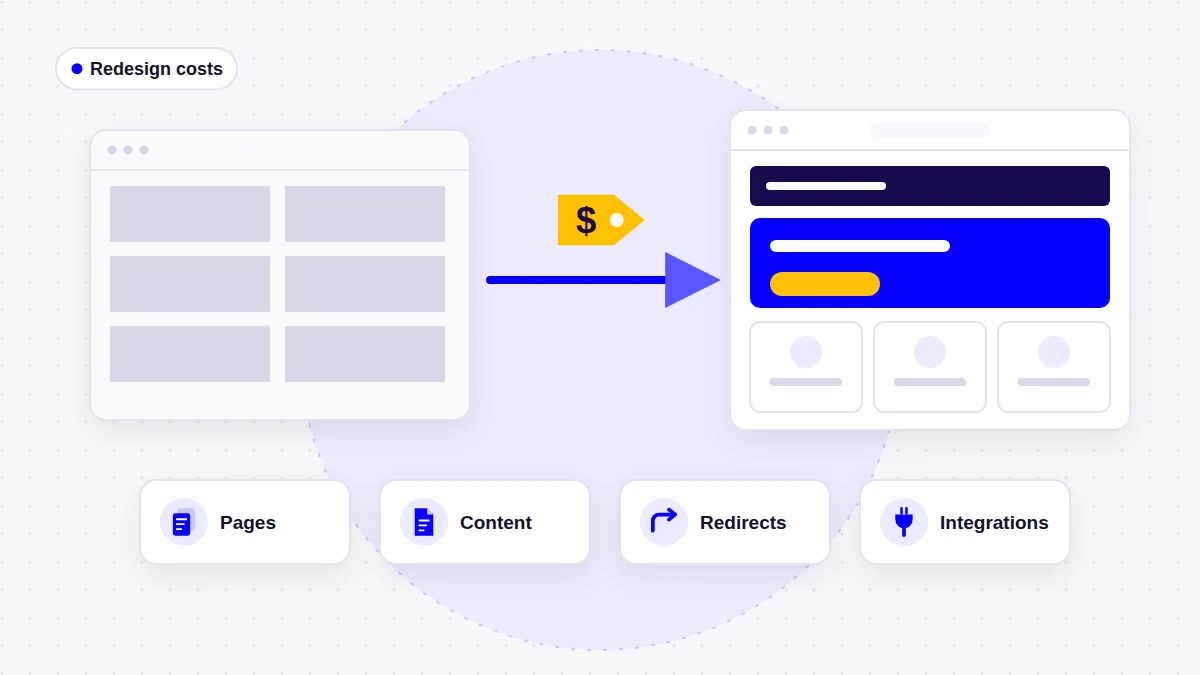
“How much will it cost to redesign my website?” is usually the first question I get from business owners who already have a WordPress site. It is a fair question, and the honest answer is that it depends less on the new design than on the site you have now: how many pages it has, what it was built with, what it connects to and how much search traffic it already earns.
This guide covers redesigning an existing WordPress website. If you are starting from nothing, the pricing works differently, and my guide to what a WordPress website costs for a small business is the better starting point.
- Quick answer
There is no standard price for a WordPress redesign. Published 2026 estimates run from a few hundred dollars for a light refresh to tens of thousands for a large rebuild. What decides where your project lands:
- How many pages and page templates need rebuilding
- The condition of the current site: theme, page builder, plugins and code
- Whether content is kept, rewritten or migrated from another structure
- How much search traffic must be protected with URL mapping and redirects
- Forms, booking tools, CRMs and ecommerce that have to keep working
- Who does the work: a freelancer, a small studio or an agency
- Whether you need a partial redesign or a complete one
What Published Pricing Guides Say in 2026
I do not publish fixed redesign prices, because two sites that look similar from the outside can need very different amounts of work. To give you a realistic frame, here is what several current pricing guides publish. These are published estimates, not quotes, and each source defines a redesign a little differently.
| Source (last updated) | Published estimate | What it describes |
|---|---|---|
| Bonnie Sorsby, Photo + Design Co. (Aug 2026) | $2,000 to $12,000 | WordPress redesign; refresh only from $500 to $2,000 |
| WebFX redesign pricing (May 2026) | $3,000 to $24,000 | Redesign of a small site (1 to 50 pages), all platforms |
| LowCode Agency (Sept 2026) | $5,000 to $18,000 | Small business WordPress redesign, 5 to 12 pages, client-supplied content |
| Huemor (June 2026) | $10,000 to $25,000 | Small business site, 5 to 15 pages, agency-led (guide written for mid-sized B2B firms) |
A few things are worth noticing. The low end of one source overlaps with the middle of another. Each guide is written by a business that sells redesigns, so the ranges partly reflect who that business usually works with: a small design studio, a large marketing agency or a B2B specialist. Huemor, for example, says most of the B2B redesigns it discusses fall between $50,000 and $150,000, which is a different market from a five-page plumbing website. LowCode Agency’s small business range explicitly excludes copywriting, custom integrations and WooCommerce.
So the useful question is not “what is the average?” but “which of these descriptions sounds like my site?” The rest of this article explains the factors behind that.
All figures are in US dollars, were checked in October 2026 and come from the linked pages. They describe typical projects in each provider’s market, not what any specific designer, including me, would charge for your site. Use them to sense-check quotes, not to set a budget to the dollar.
What Affects WordPress Redesign Cost
When I review a site before quoting, these are the things that change the amount of work the most. The table gives the overview, and the sections below explain each one.
| Cost driver | Keeps cost lower | Pushes cost higher |
|---|---|---|
| Number of pages | Few pages built from a few shared templates | Many pages, or many unique layouts |
| Existing site condition | Current WordPress, maintained plugins | Outdated core, abandoned theme, plugin conflicts |
| Theme and page builder | Already on Elementor or the block editor | Old builder leaving shortcodes behind |
| Content | Existing text kept and supplied on time | Rewriting, restructuring or new copy |
| Content migration | A handful of pages copied across | Dozens of posts, galleries or custom fields |
| SEO preservation | URLs stay the same | URL structure changes across the site |
| Forms and integrations | One contact form, email only | CRM, booking, payments or quote tools |
| Ecommerce | No shop | WooCommerce products, checkout and stock |
| Speed and security | Lean site, clean history | Bloated plugins, past malware |
| Design approach | Refined layout from an existing system | Fully custom design and new branding |
| Who does the work | Freelancer or small studio | Agency with a larger team and process |
Number of pages
Page count matters, but templates matter more. Ten service pages that share one well-built template take far less time than ten pages that each have a different layout. WebFX groups its estimates by size and puts small sites (1 to 50 pages) at $3,000 to $24,000 and medium sites (50 to 150 pages) at $24,000 to $40,000 (WebFX, updated May 2026). If you are unsure how many pages your site really needs, how many pages a small business website should have is a useful check before you ask for quotes. A redesign is a good time to merge thin pages, and that can reduce the work.
Condition of the existing website
This is the factor most owners underestimate. A site running current WordPress with a maintained theme and a sensible set of plugins is straightforward to rebuild. A site that has not been updated in years often needs work before the redesign can even start: updating PHP, replacing abandoned plugins, untangling conflicts and taking a clean backup. None of that shows on the front end, but it all takes time.
If the site is redirecting to strange domains, showing spam pages in Google or triggering security warnings, deal with that first. A restore and malware cleanup is a separate job, and redesigning on top of an infected install just carries the problem across.
Theme and page builder
What the site is built with decides whether the redesign can reuse anything. Older themes with their own built-in page builders, and builders that store layouts as shortcodes, often leave pages full of code fragments once you switch away. In that case every page has to be rebuilt by hand, even if the text stays the same.
Elementor
I rebuild redesign projects in Elementor rather than patching the old templates, so the result is a site you can edit yourself. If your site is already on Elementor, a redesign can sometimes reuse the structure and focus on new global styles, templates and sections, which keeps cost down. If it is on a different builder, budget for each page to be rebuilt. Elementor Pro is a paid annual license, and Elementor’s pricing page lists plans “from $60/year” (checked October 2026). Make sure the license is in your name, not the designer’s.
Content and content migration
A redesign can keep your existing wording largely intact, change only the layout and still make a real difference. Rewriting content, adding new service pages or restructuring the site around current services adds time, whether you do it or the designer does.
Migration is the work of moving content into the new structure: blog posts, project galleries, testimonials, custom fields and images. Published estimates give a sense of scale. KrishaWeb says agencies charge $75 to $150 per page for content audit, cleanup and migration (KrishaWeb, updated June 2026), and HyperArts puts content migration at 10% to 25% of the total project (HyperArts, updated July 2026). Five pages copied across is a small job. Eighty blog posts with embedded galleries is not.
SEO preservation and redirects
If your site already brings in search traffic, protecting it is part of the redesign, not an extra. Before anything changes, I map the existing URLs, page titles and internal links. Where possible, URLs stay exactly as they are. Where a page genuinely needs a new address, the old URL gets a 301 redirect to its replacement. This mapping is a standard part of how I run a WordPress website redesign.
Google recommends listing your old URLs, mapping each one to a new URL, using permanent server-side redirects and keeping them “generally at least 1 year” (Google: site moves with URL changes; see also Google on redirects). Google also says to expect temporary ranking changes while the site is recrawled. That is why no honest designer can guarantee rankings will not move after a rebuild. A small site that keeps its URLs needs little redirect work. A site changing its whole URL structure needs a lot more.
Forms and integrations
A single contact form that sends an email is quick to rebuild. Quote forms with conditional fields, booking tools, CRM connections, call tracking, review feeds and payment links all need to be reconnected and tested on the new site. Each integration also adds a dependency that can break at launch if nobody checks it. List every one of them before you ask for quotes, so they are priced in rather than discovered halfway through.
Ecommerce
A WooCommerce store is a different scale of project. Products, variations, checkout, payment gateways, shipping, tax and order history all have to survive the redesign, and the store usually has to keep trading while the work happens. Most published guides price ecommerce redesigns well above brochure sites, and LowCode Agency places complex WooCommerce in its enterprise tier (LowCode Agency, updated September 2026). Most of the service businesses I work with do not need a shop, and if yours does not, you should not be paying for one.
Speed optimization
A redesign is the natural time to clean up the plugins and heavy elements that build up on an older site. Some speed work comes with a good rebuild anyway: optimized images, fewer plugins, lighter templates. Hitting specific Core Web Vitals targets on a heavy site, or on cheap hosting, takes extra testing and sometimes a hosting change. Ask whether performance work is included or quoted separately.
Security
Basic hardening, such as current software, strong admin passwords and removing unused plugins and users, should be part of any rebuild. WordPress’s own hardening guide starts with keeping everything updated. Ongoing protection after launch is a separate cost, usually covered by WordPress maintenance rather than the redesign itself.
Custom design
A redesign that refines your current branding inside a clean layout system costs less than one that starts with new branding, custom illustrations and a unique design for every page. WebFX separates a “redecoration or rewire” of a small site ($3,000 to $5,000) from a “remodel or rebuild” ($7,000 to $15,000) (WebFX, updated May 2026), which shows how much the depth of design work matters on its own.
Freelancer vs Agency Redesign Costs
Who does the work changes the price as much as the work itself. Agencies have more people, more process and more overhead. Freelancers and small studios have less overhead, but one person carries more of the project.
| Provider | Published estimate | Source |
|---|---|---|
| Freelancer | $3,000 to $10,000 per redesign | WebFX (May 2026) |
| Freelancer or small studio | $1,500 to $6,000 | Bonnie Sorsby (Aug 2026) |
| Boutique agency | $6,000 to $15,000+ | Bonnie Sorsby (Aug 2026) |
| Web design agency | $5,000 to $75,000 | WebFX (May 2026) |
| Specialized agency (B2B) | $50,000 to $250,000+ | Huemor (June 2026) |
Hourly rates vary even more. Upwork reports a median of $20 per hour for WordPress developers on its platform, with a typical range of $15 to $28, based on historical contracts worldwide (Upwork, no date shown, checked October 2026). That figure mixes every country and experience level, so it says little about what an experienced specialist in your market charges.
A lower rate is not automatically a saving. The questions that matter are who maps your URLs and sets up the redirects, who tests the forms, and who is responsible if something breaks after launch. If you are hiring through a marketplace, my guide on choosing a website designer on Fiverr covers how to check scope and fit.
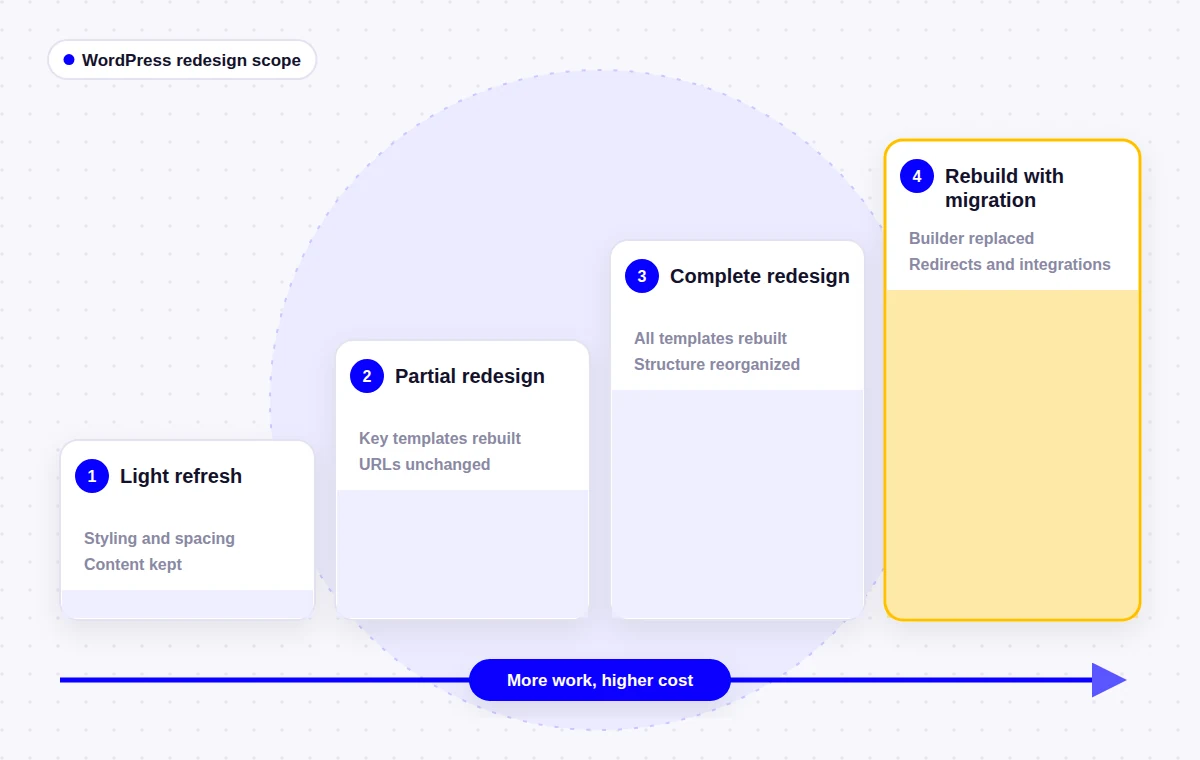
Partial Redesign vs Complete Redesign
Not every site needs a full rebuild. On many service business sites, the structure is sound and the problem is narrower: the service pages are crammed onto one page, the phone number is hard to find on mobile, or the project gallery is out of date.
| Partial redesign | Complete redesign | |
|---|---|---|
| Typical scope | Homepage, key templates or one section | Every template, structure and navigation |
| Content | Mostly kept | Often reorganized or rewritten |
| URLs | Usually unchanged | May change, so redirects are planned |
| Theme or builder | Kept | Often replaced |
| Best when | The foundation is solid | The foundation is the problem |
Bonnie Sorsby puts a website refresh at $500 to $2,000 and small section or page rebuilds at $300 to $1,000, against $2,000 to $12,000 for a WordPress redesign (Bonnie Sorsby, updated August 2026). Whatever the exact numbers in your market, the gap between a focused fix and a full rebuild is large. When a site has good bones, I would rather say so than quote for a complete redesign it does not need.
Why Two Redesign Projects Can Cost Very Different Amounts
Here are two hypothetical example projects. They are not real clients, and I have deliberately not attached prices, because the point is to show where the extra work comes from.
Example A: an 8-page plumbing website
- Already on WordPress and Elementor, updated within the last year
- Eight pages: home, four services, about, service areas, contact
- Owner is happy with the wording; only the layout and mobile experience feel dated
- URLs stay exactly the same
- One contact form that sends an email
- No shop, no booking system, no history of security problems
This is mostly design and template work. The structure is reused, nothing moves, and redirect work is close to zero. It fits the lower, “refresh” end of the published descriptions above.
Example B: a 60-page remodeling website
- Built years ago on a theme that is no longer updated, with an old shortcode-based builder
- About 60 pages and 40 blog posts, many of them thin or overlapping
- Services have changed, so pages need merging and new ones need writing
- The URL structure changes, so every old URL needs a redirect
- A quote form connected to a CRM, plus an online booking tool
- Forty active plugins, several abandoned, and a slow mobile experience
Here every page must be rebuilt by hand, the content needs restructuring, dozens of redirects must be mapped and tested, and two integrations have to be reconnected. Even if the finished site looks no more complex than Example A, the work behind it is several times larger. It sits much higher in the published ranges, and the quote should say why.
Most of the price difference comes from what is already there, not from the new design. That is why a quote based only on “how many pages do you want?” is rarely reliable.
Questions to Ask Before You Accept a Redesign Quote
- What exactly is included: how many pages and templates, and how many revision rounds?
- Will you review the existing site before quoting, or is this a standard package?
- Will my existing URLs stay the same? If not, who maps them and sets up the 301 redirects?
- Who moves the content across, and is any rewriting included?
- Which forms, integrations and plugins will be rebuilt and tested?
- Which page builder and theme will you use, and can I edit pages myself afterwards?
- Are premium plugin and theme licenses included, and will they be in my name?
- Is speed optimization included, and how will it be measured?
- How will the site be tested on mobile before launch?
- What happens if something breaks after launch, and for how long?
- Is hosting, maintenance or ongoing SEO included, or quoted separately?
The replies are as useful as the price. A designer who asks about your search traffic, your forms and your current URLs is pricing the real job. If ongoing visibility is the priority, ask how the redesign connects to technical and on-page SEO work after launch.
What to Prepare to Reduce Redesign Cost
Much of the cost of a redesign is time spent finding things out. The more of this you have ready, the less time is billed to discover it.
- WordPress admin login for the designer
- Hosting and domain account access
- Google Search Console and Analytics access
- A list of pages to keep, merge or remove
- Your most visited pages from Analytics
- Every form, booking tool and integration in use
- Plugin and theme licenses you already own
- Final wording, or notes on what must change
- Current services and service areas
- Real photos of your work and team
- Logo files and brand colors
- One person who approves changes
- Two or three sites you like, and why
- Must-have vs nice-to-have features
If you want a sense of what a finished service business site should contain, what a small business website should include is a good reference while you prepare the list.
Frequently Asked Questions
How much does it cost to redesign a WordPress website?
Published 2026 estimates range widely, from $2,000 to $12,000 for a WordPress redesign in one small studio’s guide to $3,000 to $24,000 for small sites in WebFX’s. Where your project lands depends on pages, the condition of the current site, content, integrations and who does the work. A review of the existing site is the only way to get a reliable figure.
Is it cheaper to redesign a website or build a new one?
A redesign is usually cheaper when the existing site has a solid structure and content worth keeping. When the theme, builder and content all need replacing, a redesign can cost about the same as a new build. The comparison is covered in more detail in the redesign vs new website guide.
How much does a website refresh cost compared with a full redesign?
One published guide puts a refresh at $500 to $2,000 and a full WordPress redesign at $2,000 to $12,000 (Bonnie Sorsby, updated August 2026). A refresh changes styling, spacing and some content. A full redesign rebuilds the templates and structure.
Will a redesign hurt my Google rankings?
Not if it is handled carefully. Existing URLs, titles and internal links should be mapped before the rebuild, with 301 redirects for any page that moves. Google says some temporary ranking movement is normal while a changed site is recrawled, so nobody can honestly guarantee no fluctuation.
Can I redesign my WordPress site without changing the content?
Yes. A redesign can focus on layout, structure and performance while keeping your wording largely intact, which also keeps the cost down. It is still worth checking that the content reflects your current services.
Does switching to Elementor increase the cost?
If the current site uses a different page builder or an old theme builder, pages usually need rebuilding by hand, which adds time. If the site is already on Elementor, more of the existing structure can often be reused.
How long does a WordPress redesign take?
It depends on the same factors as the cost. A small site with content ready can move quickly, while a larger site with migration, redirects and integrations takes longer. Delays most often come from waiting for content, access or approvals.
Getting a Realistic Redesign Price
WordPress website redesign cost is decided mostly by what you already have: the size and condition of the site, the content, the integrations and the search traffic you need to keep. Published ranges help you sense-check a quote, but the only reliable number comes from someone looking at your actual site.
Get two or three quotes, ask what each one includes, and pay attention to who asks about your URLs and forms. A slightly higher quote that protects your search visibility is usually cheaper than a low one that loses it.
- About the author
Arslan Kalwar is a WordPress website designer and SEO specialist who builds and redesigns Elementor websites for contractors, trades and other local service businesses. He has worked with WordPress for more than eight years, has completed 1,200+ projects and is a WordPress Core contributor. More about Arslan.
Want to Know What Your Redesign Would Involve?
Send me your website address and the trade you are in. You will get a short, honest answer on what is holding the site back, at no cost, and if a focused fix would do more than a full rebuild, I will tell you that instead.