Home / Local SEO for Contractors: What Actually Matters
- LOCAL SEO FOR CONTRACTORS
Local SEO for Contractors: What Actually Matters and What to Do First
Local SEO sounds like a long list. For a contractor it comes down to three things done properly: a complete Google Business Profile, a website with the right pages, and a steady flow of real reviews. Here is the order to do them in.
- For contractors and trades
- Priorities, not a long list
- Based on Google's own guidance
Short answer
Local SEO for a contractor has three parts: a complete and accurate Google Business Profile, a website with a page for each service and honest area wording, and real reviews from real customers. Do them in that order, keep your business details identical everywhere, and measure calls and forms rather than rankings. No one can guarantee a map pack position.
In this guide
How Google decides who shows up locally
Google says local results are mainly based on relevance, distance and prominence (Google Business Profile Help). Relevance is how well your profile matches the search. Distance is how far you are from the searcher. Prominence is how well known you are, which includes reviews. Google also says businesses with complete and accurate information are more likely to show up.
That explains most of what you can and cannot control. You cannot move closer to every customer. You can make sure your profile matches what you do, is complete, and is backed by a website and reviews that agree with it.
The three parts of local SEO for a contractor
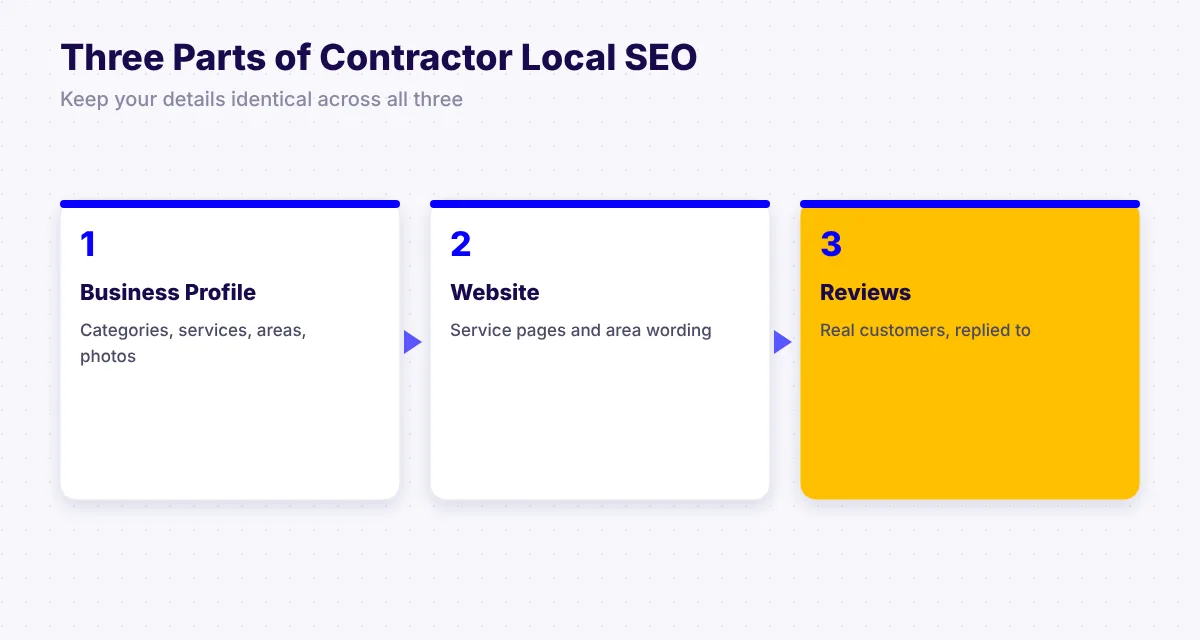
| Part | What it is | Why it matters |
|---|---|---|
| Google Business Profile | Your listing on Google Search and Maps: categories, services, areas, photos, hours | Often the first thing a customer sees and compares |
| Website | Service pages, area wording, contact paths, speed | Gives Google and customers the detail the profile cannot |
| Reviews and consistency | Real customer reviews, and the same name, address and phone everywhere | Prominence, and trust |
What to do first, in order
- Claim and verify your Google Business Profile, or take it back if someone else set it up.
- Choose accurate categories and list your main services.
- Set your service areas and hide your address if customers do not visit you.
- Make sure each main service has its own page on your website.
- Check that your name, address and phone match between the profile and the site.
- Ask every finished customer for a review, and reply to the ones you get.
- Add area wording to the site where you really work.
- Set up call and form tracking so you can see what works.
My Google Business Profile service covers steps one to three and five.
The website side of local SEO
A strong profile pointing at a weak site wastes the click. The site should have a page for each main service, clear wording about where you work and a quick way to contact you. Areas deserve care. Google’s spam policies describe near duplicate pages made to rank for place names as doorway abuse, so each area page needs real local content. I explain how in how to create service area pages that help local SEO.
Look at how real builds handle it. The WindowLab site names its two service areas, Nassau and Suffolk County, and the towns it covers, while keeping its menu to four items. The Goodman Roofing site is built around Kankakee County and covers residential, commercial and multi-family roofing. Neither relies on copied town pages.
Speed matters too. Google’s Core Web Vitals measure loading, responsiveness and visual stability, and Google says good scores do not guarantee rankings but its systems do use them. A slow page also loses the customer who is already on the site.
Reviews: ask every customer
Google says more reviews and positive ratings can help local ranking, and that replying to reviews helps you stand out. The practical routine is simple: ask every finished customer, send the link while the job is fresh, and reply to every review, good or bad, in plain language. Do not offer rewards for reviews and do not ask only happy customers; follow Google’s review policies.
What to avoid
- Stuffing keywords into your business name. Google’s guidelines for representing your business say the name should reflect your real name.
- Using a virtual office, a P.O. box or a friend’s address as your location.
- Listing towns you do not serve in the hope of showing up there.
- Copying the same page for every town and changing one word.
- Buying reviews or asking friends to write them.
- Letting the profile and the website disagree about services or hours.
How to measure it
Do not judge local SEO by a ranking screenshot. Rankings change by location and by person. Count what matters: calls from the profile, direction requests, website calls and forms, and the number of new reviews. Check them monthly and compare month to month.
Do it yourself or hire help
A lot of this is doable on your own, especially claiming and completing your profile and asking for reviews. Help is worth it when the site is the weak half, when the profile was set up by an agency and you no longer have access, or when you work across several towns and need a clean structure. I do not promise a map pack position or a ranking. What I can do is make sure the profile and the site are complete, accurate and consistent. See WordPress SEO services for the technical side and the contractor website design page for how I structure a contractor site.
- ABOUT THE AUTHOR
I am Arslan Kalwar, a WordPress website designer and SEO specialist. I have worked with WordPress for 8+ years and completed 1,200+ projects, mostly for contractors, trades and other local service businesses. I am also a WordPress Core contributor; the contributions page explains what that involves. The local SEO advice here follows Google’s own documentation and what I build into contractor sites. More about me is on my about page.
- FAQ
Local SEO Questions From Contractors
Short answers to common questions about local search for trades and contractors.
There is no fixed timeline. Profile changes are often reflected quickly, but visibility depends on your competition, your reviews and how established you already are. Judge progress by calls and forms over a few months, not by a single ranking.
Yes, in most cases. The profile shows basics, but the website explains your services, shows your work and gives Google more to understand. A profile that points to a weak or missing site wastes much of its value.
Google allows up to 20 service areas, set by city, postal code or other area, and says the boundary should stay within about two hours of driving from your location. Only list places you really serve.
If you do not serve customers at your address, Google says to remove it from your profile. If customers visit you, keep it. Check the current rules in Google's service area help page.
Google says more reviews and positive ratings can help your local ranking, and customers read them before they call. Quantity matters less than getting steady, real reviews and replying to them.
For businesses that serve a defined area, usually yes, because the work is mostly free to start: a complete profile, clear pages and reviews. Paying for help is worth considering when you lack the time or the site is the weak point.
Want Your Profile and Website Working Together?
Send me your business name, your website address and the areas you serve. You will get a clear read on what needs attention first.